
 Out of stock
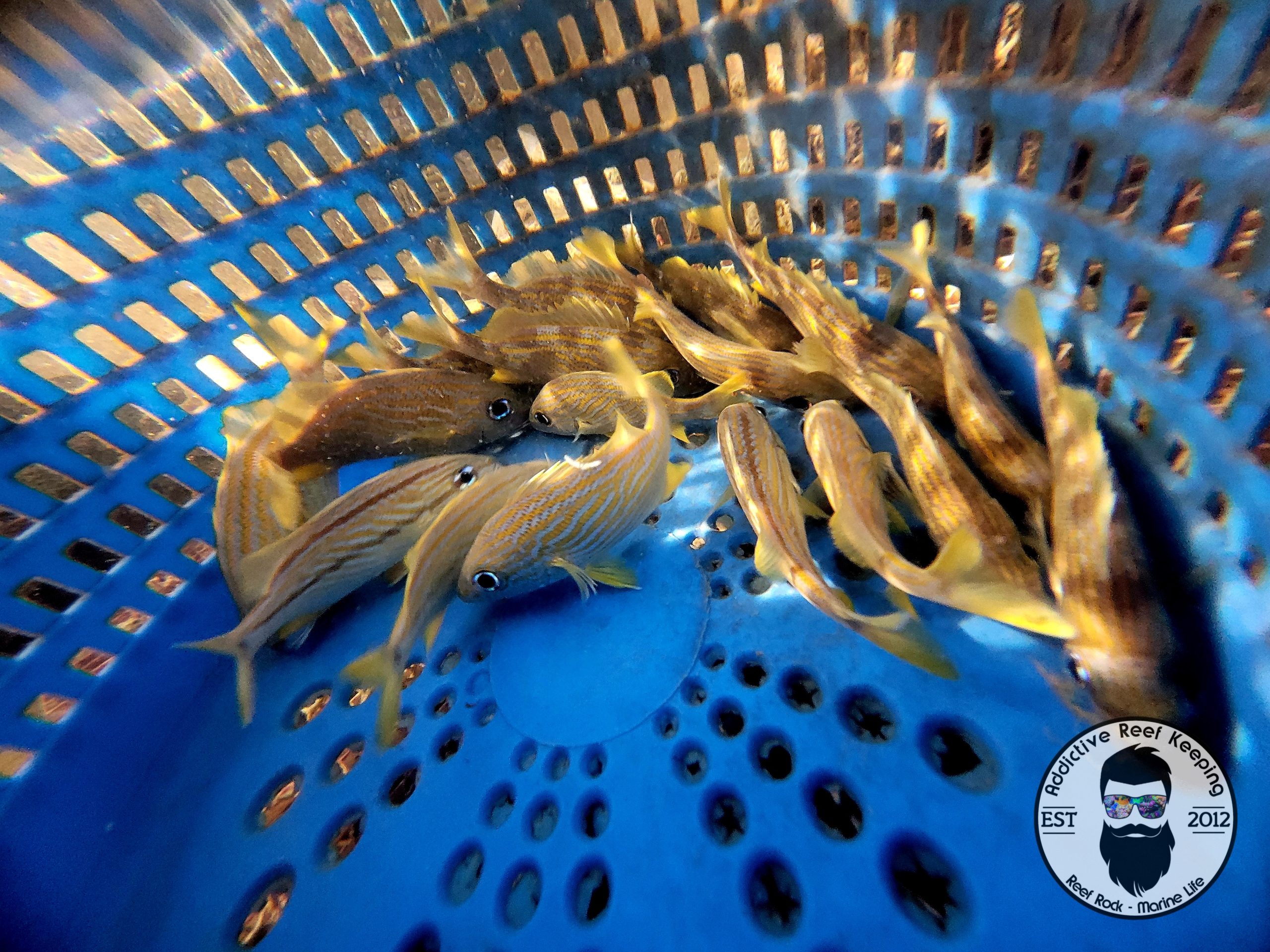
French Grunt Schooling Fish
$49.99
Ships FedEx Priority Overnight, Mon–Wed only
Covered by our Live Arrival Guarantee
From the farm
Kevin P. Barden, Matthew L. Wittenrich, and Eric J. Cassiano INTRODUCTION Grunts (family Haemulidae) are some of the most economically and ecologically important fishes found throughout the world. Their common name refers to the characteristic grunting sound they make when they are agitated and during courtship. They rub their pharyngeal teeth together to produce the sound. Grunts are distributed throughout the Atlantic, Indian, and Pacific oceans with 17 genera and approximately 150 species recognized (Nelson 2006). Fifteen species of grunts are common in the western Atlantic and often numerically dominate shallow reefs. Their abundance on coral and rocky reefs, ledges, and hard bottoms has led to a high-value fishery (1.8 million pounds landed in Florida in 2009 [FWRI 2010]). Grunts are primarily harvested by recreational anglers for their value as a food fish. Many species of grunts are popular in public and private aquariums due to their schooling behavior and bright colors that create interest in aquarium exhibits. The French grunt, Haemulon flavolineatum (Figure 1), has recently been identified as a candidate species for aquaculture due to its popularity in aquarium displays and the development of culture protocols. NATURAL HISTORY The French grunt is an abundant and ecologically important reef fish distributed throughout the Caribbean Sea and portions of the western Atlantic, from Bermuda and South Carolina to the northern Gulf of Mexico (Randall 1967). Adult French grunts typically occur in large resting schools on rocky and coral reefs, often under ledges or large stands of elkhorn coral during daylight hours. Resting schools break up during nocturnal foraging forays on nearby sand flats where they consume mainly crustacean prey such as shrimps, crabs, mantis shrimp, amphipods, and copepods (Hargrove et al. 2012; Burke 1995). Soft-bodied prey such as polychaetes and peanut worms can account for up to 35% of the diet. Juveniles are most common in near-shore seagrass and mangrove areas, feeding in daylight hours on pelagic calanoid copepods, shrimp and crab larvae, amphipods, and Mysis shrimp (Verweij et al. 2006; Lieske and Myers 1994). Larger juveniles migrate to deeper bay and mangrove areas, and subadults (~10 cm) begin to migrate towards deeper hard bottom and reef areas (de la Morinière et al. 2002). Maximum size for French grunts is reported at 30 cm total length, although 17 cm is common. Despite their high value, little is known about the reproduction and early life history of the group. Settlement of wild French grunt larvae onto reefs has been linked to biweekly moon phase events associated with peak spawning activity (Robertson, Green, and Victor 1988). Spring and summer appear to be peak spawning months in subtropical climates, but at least some spawning is reported to occur year-round, especially in warmer areas. CULTURE TECHNIQUES Although limited information is available on the aquaculture methods and systems used to rear French grunts, the University of Florida’s Tropical Aquaculture Laboratory (TAL) has developed preliminary aquaculture protocols that will help guide large-scale and continuous production of the species. BROODSTOCK AND SPAWNING French grunts reach sexual maturity at 12–15 cm (L. D. Boles, personal observation). In the wild, French grunts spawn at dusk. Male-female pairs rise together in the water column to broadcast their eggs, a behavior that is called a “spawning ascent.” At the height of their ascent, the pairs of fish release thousands of separate, spherical, floating eggs measuring slightly less than 1 mm in diameter. To cue cultured French grunts to spawn, light cycle and temperature may be manipulated to simulate spring and summer peak spawning times. Volitional spawning, without the use of hormones, is achieved by maintaining a light cycle of 12–14 hours accompanied by water temperatures of 23°C–28°C and 32–35 g/L salinity. Fecundity is influenced by water temperature with higher temperatures 26°C–28°C maximizing egg output (L. D. Boles, personal observation). A